Hydraulic Breaker for Backhoe Loaders: The Complete Buyer’s Guide
2026-09-16

For users preparing to purchase a hydraulic breaker for a Hitachi excavator, achieving the perfect balance between the excavator’s hydraulic system and the breaker’s performance parameters is the core factor that dictates operational efficiency and minimizes maintenance costs. As a leading brand in the global hydraulic breaker industry, the Beilite (BLTB) series has commanded a massive market share owing to its high impact energy, superior stability, and exceptional compatibility.
Whether your fleet utilizes the ZX55U / ZX70 mini excavators (highly regarded as municipal jobsite assets), the ZX200 Series (such as the ZX200-5G and ZX200-6) which serve as the backbone of mid-sized construction, or the massive ZX330 / ZX470 heavy-duty quarry giants, Beilite provides the ultimate profitability-driven equipment combination.
This comprehensive guide integrates the most prevalent Hitachi excavator models—ranging from 3-ton mini diggers to 47-ton heavy-duty mining excavators—with Beilite’s official technical specifications to deliver the most professional, accurate, and intuitive selection roadmap.
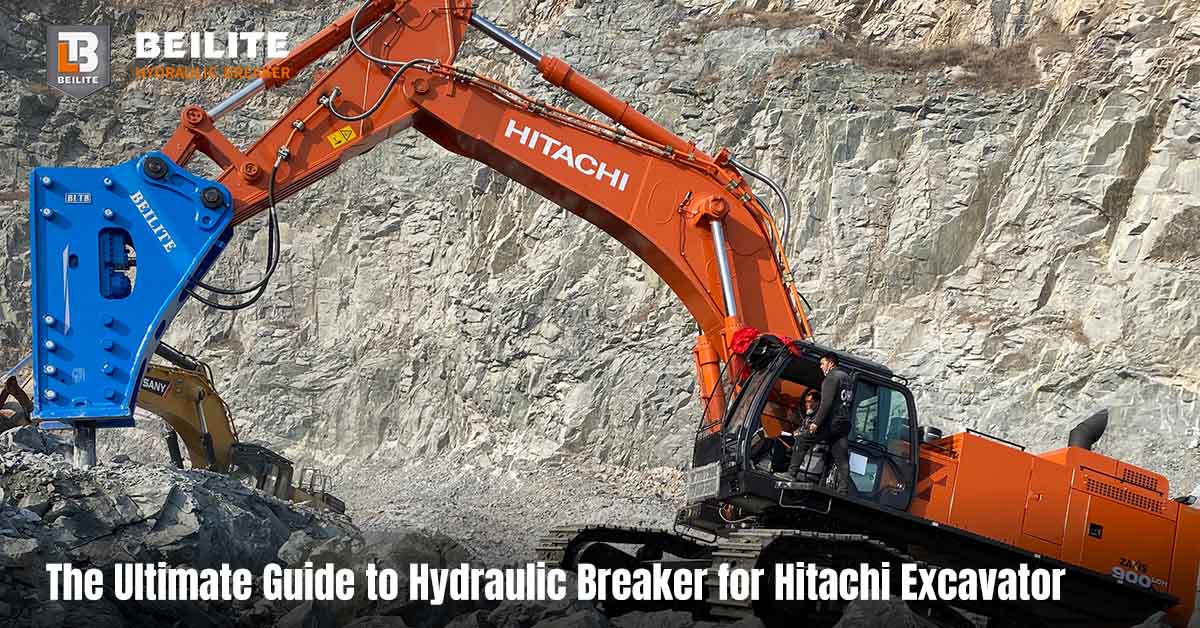
Based on the global distribution and population of Hitachi excavators, the following sections detail the optimal Beilite (BLTB) hydraulic breaker models alongside their critical engineering specifications:
Operational Work Environments:
This carrier class primarily targets tight, space-constrained urban, indoor, and landscaping jobsites where extreme operational precision and strict environmental regulations are required. Typical applications include residential interior strip-outs (demolishing non-load-bearing walls and concrete slabs for building renovations where narrow access and floor-load limits necessitate highly agile carriers and lightweight attachments), municipal utility works (breaking asphalt roads, sidewalk pavement, and clearing obstructions for water/gas pipe trenching), and landscape/agricultural land reclamation (breaking footpaths, decorative rocks, and clearing shallow surface rock outcroppings). These applications demand exceptionally agile excavators and lightweight breakers that deploy rapidly while mitigating strict urban noise and dust control restrictions.
| Hitachi Excavator Model | Operating Weight | Recommended Beilite Model | Chisel Diameter | Operating Flow (L/min) | Operating Pressure (bar) | Impact Energy (J) |
| ZX30U | 3 Ton | BLTB-53 | 53 mm | 20 – 50 | 90 – 120 | 350 |
| ZX35U | 3.5 Ton | BLTB-60 | 60 mm | 30 – 60 | 100 – 130 | 440 |
| ZX55U | 5.5 Ton | BLTB-70 / 70C | 70 mm | 40 – 70 | 110 – 140 | 540 |
| ZX70 | 7 Ton | BLTB-85 / 85C | 85 mm | 60 – 100 | 130 – 160 | 1260 |
Technical Selection Analysis: Hitachi mini excavators (such as the ZX55U and ZX70) are globally renowned for their responsive handling, zero/short-tail swing design, and fuel economy. Pairing them with the BLTB-70 or BLTB-85 fully capitalizes on Hitachi’s highly sensitive pilot hydraulic circuit. This synchronization delivers an exceptionally high blow rate (ranging from 400 to 800 bpm) for rapid asphalt scaling and concrete floor breaking without generating destructive hydraulic spikes that could compromise the carrier’s sensitive valving.
Related Reading: Top 10 Hydraulic Hammer Manufacturers for Bobcat Excavators
Operational Work Environments:
This carrier class represents the industry’s versatile “Golden Tonnage,” operating in fast-track, high-intensity, and multi-functional medium-scale earthmoving and urban infrastructure developments. Typical applications involve structural demolition and concrete beam/column crushing of commercial complexes and decommissioned factories; large-scale highway rehabilitation, overpass deck breaking, and pavement widening projects; as well as foundation pit excavations, trenching through low-to-medium hardness strata, and subgrade rock breaking. These demanding environments dictate a continuous, high-intensity duty cycle, requiring a hydraulic attachment that delivers an optimized balance of brutal single-blow impact energy and exceptional cycle-time efficiency when cutting through heavily reinforced concrete and varying geologies.
| Hitachi Excavator Model | Operating Weight | Recommended Beilite Model | Chisel Diameter | Operating Flow (L/min) | Operating Pressure (bar) | Impact Frequency (bpm) |
| ZX120 / ZX130 | 12 – 13 Ton | BLTB-100 | 100 mm | 80 – 110 | 150 – 170 | 350 – 700 |
| ZX135US | 13.5 Ton | BLTB-125 | 125 mm | 90 – 120 | 150 – 170 | 350 – 650 |
| ZX160 | 16 Ton | BLTB-135 / 135G | 135 mm | 120 – 180 | 160 – 180 | 350 – 500 |
| ZX200 / -5G / -6 | 20 Ton | BLTB-140 | 140 mm | 120 – 180 | 160 – 180 | 350 – 500 |
Core Recommendation: The “Golden Match” of Hitachi ZX200 & Beilite BLTB-140
The Hitachi ZX200 series (including the 5G and Gen-6 lines) represents one of the highest-population 20-ton class excavators globally, celebrated for its HIOS hydraulic system’s exceptional intelligent flow-distribution architecture. Pairing it with the Beilite BLTB-140 (140mm tool diameter) generates a monumental single-blow impact force (up to 5400 J). Because its operating flow demand (120–180 L/min) aligns seamlessly with the ZX200’s main pump output capacity, this setup stands as the heavy construction industry standard for bulk earthworks and heavy concrete recycling—guaranteeing prolonged, continuous production cycles without triggering hydraulic oil overheating.
Related Reading: Top Hydraulic Hammer Supplier for Liebherr Excavator
Operational Work Environments:
This massive tier represents the true heavy-duty, severe-service industrial extraction workspace, characterized by hostile operating environments and high-resistance mineral deposits. Typical applications encompass primary and secondary breaking in open-pit mines and large aggregate quarries, hard-rock tunneling, hydro-power intake excavations, and massive deep-cut rock scaling along highway right-of-ways. The materials processed consist primarily of high-density, high-compressive-strength, and highly abrasive rock types such as granite, basalt, quartzite, and thick-bedded limestone. These unforgiving forces demand extreme structural structural integrity from the carrier’s boom and arm, while requiring a hydraulic breaker engineered with maximum single-blow kinetic energy capable of inducing massive stress cracks to fracture monolithic rock masses.
| Hitachi Excavator Model | Operating Weight | Recommended Beilite Model | Chisel Diameter | Operating Flow (L/min) | Operating Pressure (bar) | Single Impact Energy (J) |
| ZX240 | 24 Ton | BLTB-150 / 150G | 150 mm | 150 – 210 | 180 – 200 | 6172 |
| ZX330 | 33 Ton | BLTB-155 | 155 mm | 180 – 240 | 200 – 220 | 15000 |
| ZX350 | 35 Ton | BLTB-165 | 165 mm | 200 – 260 | 210 – 230 | 19000 |
| ZX470 | 47 Ton | BLTB-175D / 175L | 175 mm | 210 – 260 | 230 – 250 | 24000 |
Recommend Reading: Top 10 Hydraulic Hammer Manufacturers for CAT Excavator
For identical internal power cells (e.g., BLTB-85 or BLTB-150), Beilite engineered three distinct housing configurations. Owners should match the configuration to their specific regulatory and jobsite parameters:
Side Type (Open Structure / Triangular Bracket):
Top Type (Vertical Straight Structure):
Box / Silenced Type (Fully Enclosed Housing):
Related Reading: Top Hydraulic Breaker Brands for Komatsu Excavators
To safeguard the high-precision hydraulic components of your Hitachi excavator and secure the longest possible service life for your Beilite breaker, operators must strictly adhere to these protocols:
Avoid Blank Firing
Never activate the breaker unless the chisel tool is firmly pressed down against the material! Blank firing (blank striking) causes severe tensile stress on the Beilite breaker’s piston, tool retainers, and through-bolts, while sending destructive residual shockwaves back into the Hitachi excavator’s boom and arm structures.
Never Use as a Prying Leverage Tool
Once the chisel penetrates hard rock or concrete, never rake, pull, or lift using the excavator arm to pry stone masses apart. This aggressive lateral sideloading causes immediate tool binding, leading to broken chisels, cracked front guide cylinders, or structural failure of the excavator’s stick cylinders.
Execute the Correct Greasing Posture
When pumping grease into the tool bush, the hydraulic breaker must be positioned vertically with full down-pressure applied against the ground so the chisel is pushed completely up into the housing against the piston. If greased while suspended in mid-air, grease will pack the void between the tool and the piston cavity. Upon operation, the piston will compress this grease, generating extreme reverse hydraulic pressure that instantly blows past the lower oil seals.
Rigidly Monitor Oil Temperature and Fluid Contamination
Hydraulic breaking degrades and oxidizes hydraulic oil three to five times faster than normal bucket digging operations. Hitachi owners must cut their hydraulic fluid and filter replacement intervals in half (it is highly recommended to swap hydraulic return filter elements every 600 to 800 hours) and closely monitor the system to ensure operating oil temperatures do not exceed 80°C.
Combining Hitachi’s high-precision, responsive hydraulic management with Beilite’s ultra-reliable, high-impact kinetic energy creates one of the most profitable assets in the modern construction sector. Prior to purchase, please consult your authorized regional Beilite distribution expert with your exact Hitachi model and field applications to obtain customized line-piping tuning and optimized installation support!





 Phone/ Whatsapp:
  Email: