Hydraulic Breaker for Backhoe Loaders: The Complete Buyer’s Guide
2026-09-16

When choosing a concrete breaker for a skid steer, one of the first specifications you need to check is hydraulic flow. A breaker that is too small for the available hydraulic system may not deliver the expected productivity, while a breaker that requires less flow than the skid steer provides may not make full use of the machine’s capabilities.
Most skid steer hydraulic breakers operate within a hydraulic flow range of approximately 10–30 GPM (38–114 L/min), depending on the breaker size and design. Smaller compact breakers may require around 10–15 GPM, medium models often operate around 15–20 GPM, while larger heavy-duty breakers can require 20–30 GPM or more.
However, hydraulic flow alone should never be used to select a breaker. Hydraulic pressure, skid steer operating weight, auxiliary hydraulic configuration, breaker weight, and the application must also be considered.
This guide explains how hydraulic flow affects skid steer concrete breaker performance and how to select the right breaker for your machine using real engineering specifications.
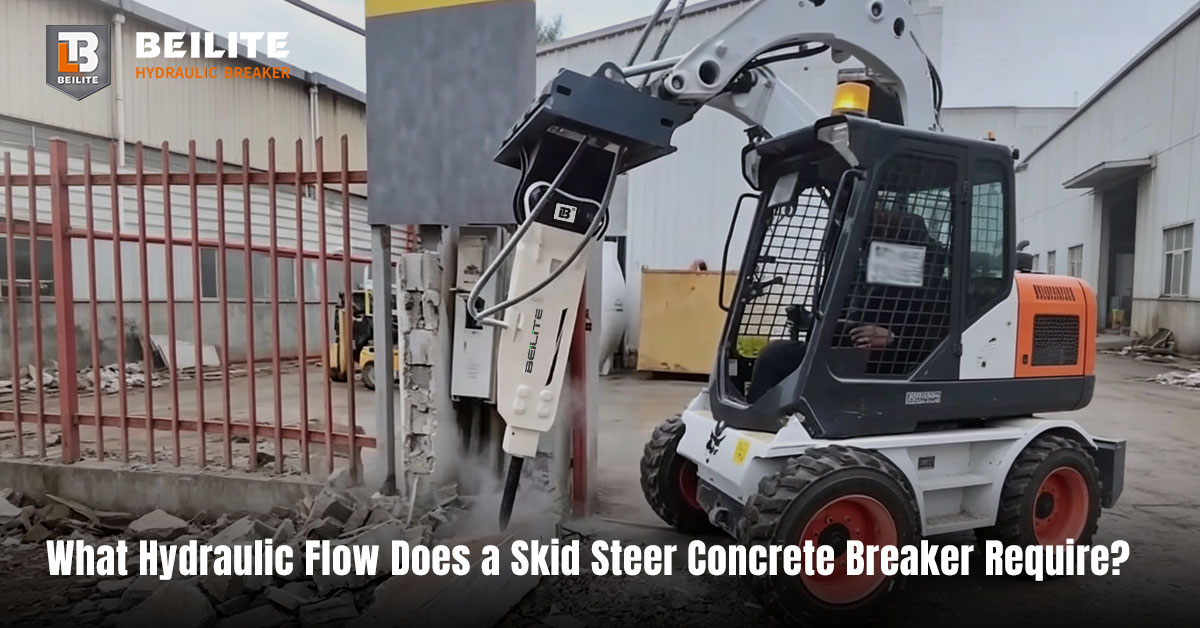
The exact hydraulic flow requirement depends on the breaker model. For example, BEILITE’s light-to-medium breaker lineup matches a wide variety of compact skid steer auxiliary hydraulic systems:
Always compare the actual flow requirement of the hydraulic breaker with the auxiliary hydraulic output of your skid steer. A 15 GPM skid steer, for example, is an excellent match for a breaker like the BLTB-75 (13.2–23.8 GPM range). However, it would not be a suitable match for a larger model requiring 25–30 GPM.
Recommended Reading: Hydraulic Breaker for 40 Ton Excavator For Sale
The best approach is to compare the specifications of both machines before making a purchase.
Step 1: Check Your Skid Steer’s Auxiliary Hydraulic Flow
Start by identifying the auxiliary hydraulic flow rate of your skid steer. Many skid steers are available with different hydraulic configurations, including standard-flow and high-flow auxiliary systems. Check the operator’s manual or specification sheet for:
Do not rely only on the skid steer’s engine horsepower or operating weight. These specifications do not tell you the actual hydraulic flow available to the attachment.
Step 2: Check the Breaker’s Required Flow Range
Next, check the hydraulic breaker manufacturer’s specifications. A breaker is rated for a specific operational range rather than a single flow value.
For instance, the BEILITE BLTB-85 specifies a working flow range of 60–100 L/min (15.9–26.4 GPM). If your skid steer provides 20 GPM, it sits comfortably within that band and ensures stable cycling without stalling or overheating.
Step 3: Check Hydraulic Pressure
Hydraulic flow is only half of the compatibility equation. You must also align the skid steer’s relief pressure with the breaker’s required working pressure and relief valve threshold:
Step 4: Check the Carrier Weight
The skid steer must be capable of safely carrying the hydraulic breaker. An oversized breaker on a light carrier compromises stability, lifting capacity, and safety. BEILITE matches carrier weights to breaker models to ensure operational stability:
Recommended Reading: Hydraulic Breaker for CAT 305 Mini Excavator For Sale
Recommended Reading: Hydraulic Hammer for 50-Ton Excavators For Sale
Recommended Reading:Is Higher BPM Always Better for Hydraulic Breakers?
| Specification | BLTB-75 | BLTB-85 | BLTB-100 |
| Working Flow | 50–90 L/min (13.2–23.8 GPM) | 60–100 L/min (15.9–26.4 GPM) | 80–110 L/min (21.1–29.1 GPM) |
| Working Pressure | 120–150 bar (1740–2175 psi) | 130–160 bar (1885–2321 psi) | 150–170 bar (2175–2465 psi) |
| Relief Pressure | 180 bar (2611 psi) | 180 bar (2611 psi) | 210 bar (3046 psi) |
| Impact Rate | 400–800 bpm | 400–800 bpm | 350–700 bpm |
| Impact Energy | 785 J | 1260 J | 1960 J |
| Chisel Diameter | 75 mm (3.0 in) | 85 mm (3.3 in) | 100 mm (3.9 in) |
| Back Head Pressure | 14–17 bar (203–247 psi) | 14–17 bar (203–247 psi) | 14–17 bar (203–247 psi) |
| Accumulator Pressure | 55–60 bar (798–870 psi) | 55–60 bar (798–870 psi) | 55–60 bar (798–870 psi) |
Choosing the right skid steer breaker isn’t about picking the largest model—it’s about balancing four core engineering metrics:
Operating outside recommended specs leads to lost productivity, excessive heat, and avoidable equipment wear. By matching your skid steer’s exact hydraulic profile to precision-engineered attachments like the BEILITE BLTB series, you unlock peak breaking power and maximum uptime.
Ready to Upgrade Your Demolition Efficiency?
Don’t leave attachment performance to guesswork. Contact the BEILITE Engineering Team today with your skid steer model, flow rate, and job site requirements—we’ll help you select the perfect factory-backed hydraulic breaker for your machine.





 Phone/ Whatsapp:
 Email: