Hydraulic Breaker for Backhoe Loaders: The Complete Buyer’s Guide
2026-09-16

In mining, quarrying, demolition, and infrastructure construction, the choice of excavator attachments has a direct impact on productivity, operating cost, and equipment lifespan. Among the most widely used hydraulic attachments, the Hydraulic Hammer (Hydraulic Breaker) and the Hydraulic Pulverizer are often compared and sometimes misunderstood.
Many contractors treat them as interchangeable tools, which often leads to inefficient operation, increased maintenance costs, and unnecessary delays. In reality, these two attachments are not competitors but complementary tools designed for different stages of demolition and material processing.
Understanding how they work and where they perform best is essential for optimizing construction workflows and maximizing return on investment.
The core difference lies in their working principles.
A Hydraulic Hammer converts hydraulic energy into high-frequency impact energy. A piston inside the hammer repeatedly strikes a tool (chisel), transferring concentrated force to rock or concrete surfaces. This “impact-breaking” method is ideal for fracturing hard and brittle materials. It usually has different housing, including box type hydraulic hammer, top type hydraulic hammer, side type hydraulic hammer, etc.
A Hydraulic Pulverizer, on the other hand, relies on hydraulic cylinders that generate massive crushing force. Its jaws slowly close to compress and crush concrete structures while integrated cutting blades shear exposed rebar. This is a “compression-crushing” method.
In simple terms:
This fundamental difference determines their ideal applications.
The hydraulic hammer is a core attachment in quarrying, mining, and heavy demolition operations. Mounted on an excavator, it uses hydraulic pressure to drive a piston at high speed, generating repeated impacts that propagate cracks inside hard materials until they fracture.
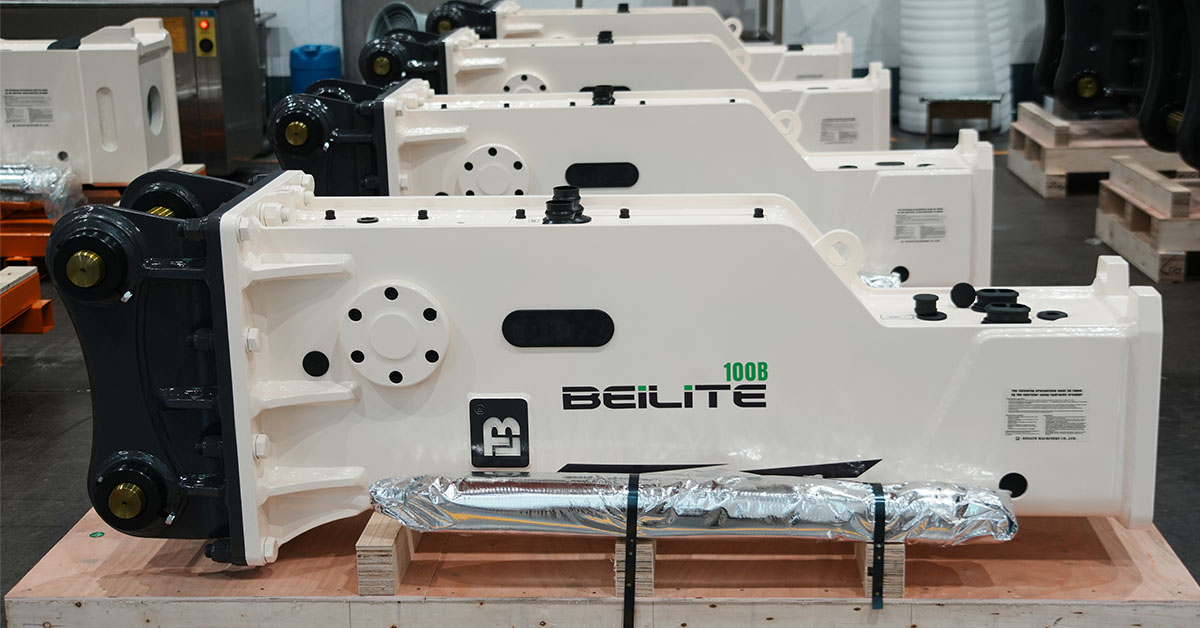
Modern high-performance hydraulic breakers are typically built with:
These features improve impact energy while reducing stress on the excavator’s hydraulic system.
Hydraulic hammers are widely used in:
They are especially useful in areas where blasting is restricted or impractical.
In quarry environments, large rock formations must be broken into smaller, manageable sizes. Due to the hardness and density of natural stone, pulverizers are ineffective at gripping solid rock. Hydraulic hammers, however, deliver concentrated impact force that efficiently fractures rock formations.
Hydraulic breakers are essential in heavy demolition tasks such as:
For reinforced concrete structures thicker than 500 mm, hydraulic hammers are often the only practical solution capable of achieving sufficient penetration and fragmentation.
| Application Scenario | Recommended Beilite Model Series | Chisel Diameter Range | Core Advantages | Compatible Excavator Tonnage |
| Urban Infrastructure & Building Demolition | BLTB-100 to BLTB-135 (Silenced/Box Type Preferred) | 100 – 135 mm | Low noise, high mobility, and excellent penetration into concrete. | 10 – 24 t |
| Medium-Sized Quarries & Heavy-Duty Demolition | BLTB-140 to BLTB-165 | 140 – 165 mm | High impact frequency, high productivity, balancing hardness and speed. | 24 – 45 t |
| Large-Scale Mining & Non-Blasting Operations | BLTB-175 to BLTB-280 (Heavy-Duty Silenced Type Preferred) | 175 – 280 mm | Massive impact energy (up to 69,000 J), highly shock-resistant, and wear-resistant structure. | 45 – 120 t |
Recommended Reading: How Long Should You Use a Hydraulic Breaker For ?Hydraulic Breaker Operation Time
Once the main structure has been demolished, large amounts of reinforced concrete debris remain on-site. This is where hydraulic pulverizers become essential.
Unlike hammers, pulverizers do not rely on impact force. Instead, they use hydraulic cylinders to slowly close the jaws, applying extreme crushing pressure to break concrete into smaller pieces. At the same time, built-in steel cutters shear exposed rebar, enabling efficient separation of steel and concrete.
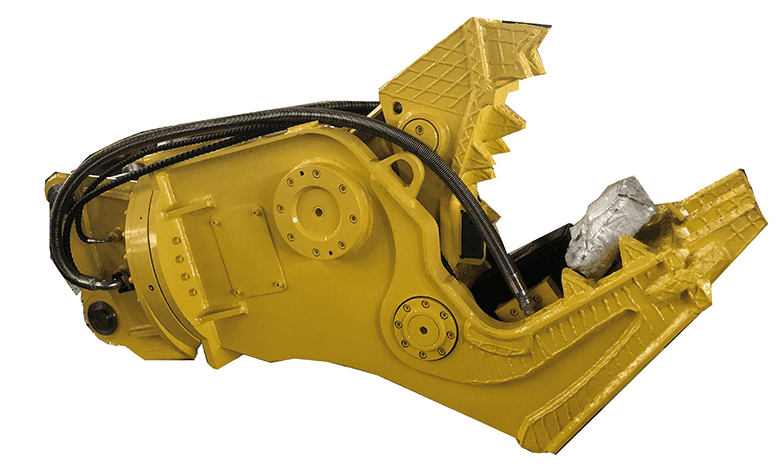
Because pulverizers operate without continuous impact, they generate significantly less noise compared to hydraulic hammers.
This makes them highly suitable for:
Continuous impact from hydraulic hammers can cause fatigue stress on excavator booms, arms, and pins. Pulverizers operate with steady hydraulic force, significantly reducing:
This contributes to longer excavator service life and lower maintenance costs.
Pulverizers enable simultaneous:
This makes them highly effective in construction waste recycling and material recovery operations.
Professional demolition contractors rarely rely on a single attachment. Instead, they typically follow a two-stage workflow:
The hydraulic hammer is used to break down the main structure into large, manageable pieces.
Typical targets include:
The goal is rapid structural fragmentation.
After the initial demolition, pulverizers are used to process the debris:
This combined workflow significantly improves efficiency while reducing transportation and landfill costs.
One of the most overlooked factors when selecting attachments is hydraulic system compatibility. Equipment weight alone is not enough; hydraulic parameters determine actual performance.
Typically requires:
Working pressure range:
Key considerations:
Excess pressure can damage seals and internal components.
Typically requires:
Working pressure:
Some advanced models include speed valve systems to reduce cycle time and improve efficiency.
Before selection, operators must verify:
Proper matching ensures optimal performance and safety.
Choose a Hydraulic Hammer if your project involves:
Choose a Hydraulic Pulverizer if your project involves:
For large-scale demolition projects, the optimal solution is often to use both attachments together: primary breaking with a hydraulic hammer, followed by secondary processing with a pulverizer.
Recommend Reading: Top 10 Excavator Hydraulic Breaker Manufacturers & Suppliers Brands
BEILITE is a professional manufacturer and solution provider of hydraulic attachments for excavators, specializing in delivering efficient and reliable engineering solutions for construction, mining, quarrying, and demolition industries. With a strong focus on innovation, durability, and performance, BEILITE develops a full range of products including hydraulic breakers, pulverizers, shears, and other excavator attachments designed to maximize productivity in the toughest working conditions. Beyond equipment manufacturing, BEILITE is committed to providing complete application-oriented solutions that help customers improve operational efficiency, reduce maintenance costs, and achieve higher returns on every project.
Hydraulic hammers and hydraulic pulverizers serve distinct but complementary roles in modern construction and demolition workflows.
The hydraulic hammer delivers powerful impact energy for primary breaking of rock and large structures, while the pulverizer efficiently processes debris and separates materials for recycling.
Selecting the right attachment—or combining both—can significantly improve construction efficiency, reduce equipment wear, lower operating costs, and enhance overall project profitability.
Before making a decision, contractors should carefully evaluate material type, construction phase, and excavator hydraulic specifications to ensure optimal equipment matching.
Ready to boost your demolition efficiency? Contact us today to get the right hydraulic hammer solution tailored to your excavator and project needs.




 Phone/ Whatsapp:
  Email: