Hydraulic Breaker for Backhoe Loaders: The Complete Buyer’s Guide
2026-09-16

Tearing up curbs isn’t just about brute force; it’s about surgical precision. When we tackle urban infrastructure, relying on manual labor is too slow, and using oversized mining hammers causes unnecessary collateral damage. That is why a specialized hydraulic breaker for curb stone breaking is the industry standard for road maintenance. These tools offer the perfect balance of power and control, allowing operators to maneuver in confined city streets where space is at a premium.
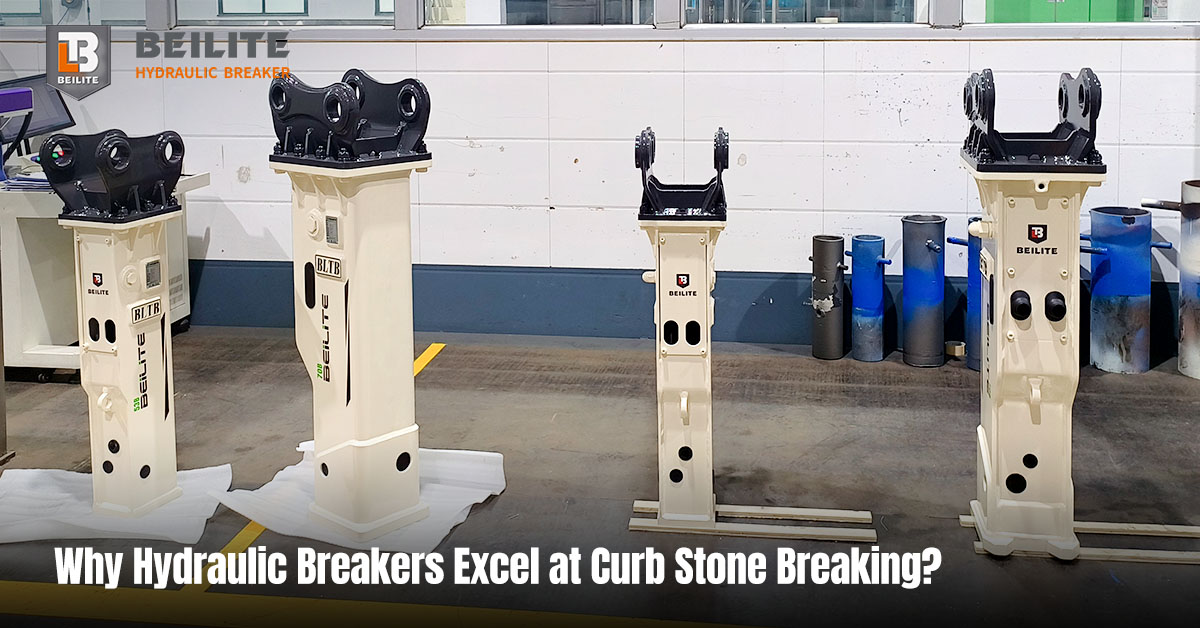
Unlike the massive breakers we design for open quarries, the units best suited for curbs—typically mounted as a skid steer hydraulic breaker or on a mini excavator—deliver high-frequency impacts. This rapid striking action allows for precision shearing rather than indiscriminate crushing.
Related Reading: The Role of Hydraulic Hammer for Road Renovation in Modern Road Projects
Most modern curbs are constructed from reinforced concrete or tough granite edges. A mini excavator concrete breaker optimized for this work uses medium-frequency energy to exploit the natural fault lines in these materials. This approach ensures a clean break, making debris removal significantly faster and safer. By minimizing vibration transmission, we also protect nearby underground utilities and adjacent structures from stress fractures, ensuring the job site remains safe and compliant.
When outfitting your fleet for road repairs, selecting the correct hydraulic breaker for curb stone breaking comes down to matching the tool to the specific constraints of urban environments. You aren’t stripping a quarry; you are working in tight, populated spaces where precision beats raw power.
Related Reading: Hydraulic Breaker for Ore Lump Breaking: A Comprehensive Guide
For efficient curb stone removal, you are likely running 0.8–8 ton mini-excavators or utilizing a skid steer hydraulic breaker setup. It is vital to strictly match the breaker’s hydraulic flow and pressure requirements (typically 130–160 bar for our compact models) to your machine.
The mounting style significantly impacts your crew’s workflow during concrete curb demolition:
Related Reading: Maximizing Productivity: Selecting the Best Hydraulic Breaker for Demolition Projects
14 Common Uses of Hydraulic Breakers
You don’t need massive force to crack a curb; you need speed. Look for a compact hydraulic hammer delivering 800–1400 blows per minute (BPM). This high-frequency impact creates clean fractures in reinforced concrete or granite edges without pulverizing the sub-base or damaging adjacent asphalt. A curb removal attachment in the 300–800 joule range provides the sweet spot for breaking power versus control.
Reliability keeps the job profitable. We build our breakers with a nitrogen-charged accumulator to maintain consistent impact power, even when hydraulic oil temperatures rise during continuous use. Furthermore, features like anti-blank firing protection and high-grade, wear-resistant bushings are critical. These technologies prevent internal damage when the tool isn’t firmly pressed against the target, extending the lifespan of your municipal concrete breaker.
When outfitting a hydraulic breaker for curb stone breaking, picking the right working steel is just as critical as the hammer itself. You can’t just slap any bit on and expect clean results. For urban infrastructure jobs where precision matters, the shape of the bit determines how the energy transfers into the concrete.
Here is how I break down the selection for curb stone removal tools:
To get the most out of your investment, maintenance is key. Concrete is abrasive, and curb work is repetitive. I always advise operators to rotate the tool bit regularly during the shift. This ensures the steel wears evenly rather than developing a flat spot, which extends the life of both the bit and the bushing.
Related Reading: The Ultimate Guide to Using an Excavator Breaker for Landscaping Projects
At Beilite, we understand that municipal roadwork demands more than just raw power; it requires precision and environmental compliance. We have engineered our hydraulic breaker for curb stone breaking to tackle the specific challenges of urban infrastructure, ensuring you get the job done without disrupting the neighborhood.
Noise regulations are getting stricter in US cities. That is why our Sound Suppressed (Silent) range is the go-to choice for street-level demolition. We utilize advanced MIC shock absorption technology, which achieves a 30% noise reduction compared to standard open-type breakers.
For curb removal, you are typically working with compact carriers in tight spaces. Our mini-series is designed specifically as a mini excavator concrete breaker, offering high maneuverability without sacrificing hitting power.
Top Models for Curb Work:
These units operate with an impact frequency of up to 1400 bpm. This high-frequency striking is essential for creating clean fractures in concrete curbs, allowing for easy removal while protecting the underlying asphalt.
Related Reading: Do you Know this about Hydraulic Breakers for River Dredging?
Roadwork is dusty and gritty. We build our breakers to last in these abrasive conditions. Our units feature sand-resistant seals and a fully dust-proof design, preventing internal contamination that kills lesser hammers. Whether you mount this as a skid steer hydraulic breaker or on a backhoe, our ISO-certified manufacturing ensures consistent performance.
If you want your hydraulic breaker for curb stone breaking to last through tough seasons, you have to stay on top of maintenance. Neglect leads to downtime, and on a tight municipal schedule, downtime kills your profit margin. Here is how I keep my equipment running smooth.
You don’t need a full shop to do the basics. Make these checks a habit for every operator running a mini excavator concrete breaker:
I have seen plenty of good attachments ruined by bad habits. To protect your curb removal attachment:
When you finish a concrete curb demolition job, don’t just toss the breaker in the mud.
For precise curb work, the chisel bit hydraulic breaker tool is generally the top choice. Unlike a moil point which penetrates in a cone shape, a chisel (wedge) directs the impact energy linearly. This allows operators to control the fracture line along the curb edge, shearing the concrete cleanly from the asphalt without shattering the surrounding pavement. For our Beilite mini-series (like the BLTB-40 or BLTB-53), we recommend sticking to the standard wedge chisel to maximize splitting force on reinforced concrete edges.
Urban noise ordinances are strict, making a standard open-bracket hammer risky for city contracts. To stay compliant, you should utilize a silent hydraulic hammer. Our Sound Suppressed range features a fully enclosed box design and MIC shock absorption technology, which reduces operating noise by approximately 30% compared to side-mounted units. This makes them the ideal low noise concrete breaker for residential streets and downtown zones where minimizing disturbance is critical.
Absolutely. In fact, a mini excavator concrete breaker is often preferred over larger machines for curb jobs due to better maneuverability in tight lanes. The key is matching the breaker to the carrier’s weight and hydraulic flow.
Concrete dust is highly abrasive, so protecting the internals is vital.





 Phone/ Whatsapp:
  Email: