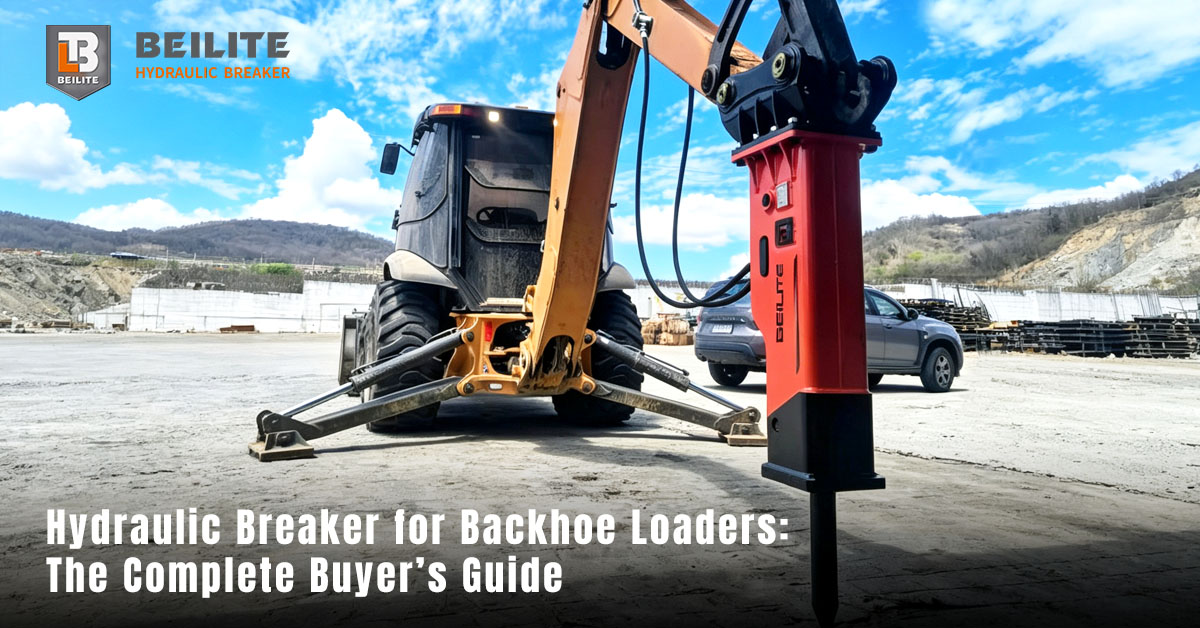
Hydraulic Breaker for Backhoe Loaders: The Complete Buyer’s Guide
2026-09-16

A hydraulic hammer‘s performance hinges on its size configuration—a carefully balanced set of parameters that determine how well it works with a carrier, breaks specific materials, and withstands operational stress. Hydraulic hammer size configurations are not arbitrary; they are engineered to align with carrier capabilities, job requirements, and durability needs. At BEILITE, we’ve spent decades refining these configurations, blending material science and field data to create hammers that outperform in real-world conditions. Let’s break down the critical elements of size configurations and why they matter.
Hydraulic hammer size configurations are defined by interrelated technical parameters, each playing a role in how the hammer interacts with its carrier and the material it breaks. Understanding these parameters is the first step in selecting the right size.
These parameters are not independent. For example, a larger working tool diameter requires a heavier service weight to maintain balance, which in turn demands a larger carrier. At BEILITE, we map these relationships using proprietary software, ensuring each configuration is a cohesive system.
Recommend Reading: What is a Hydraulic Breaker? Your Complete Guide to Breaker Hydraulics
The most critical aspect of size configuration is matching the hammer to the carrier’s weight class. Carriers (excavators, skid steers, and backhoes) have specific lifting capacities and hydraulic output limits; a mismatch risks structural damage or underperformance. This is because the carrier’s boom, arm, and hydraulic pump are engineered to operate within a weight range—exceeding it causes excessive stress, leading to cracked booms or leaky hydraulic lines. BEILITE’s size configurations are rigorously tested with carriers across weight classes. This precision ensures the carrier and hammer work in harmony, reducing wear on both.
BEILITE offers a wide range of hydraulic hammer models, from the smaller BLT40 suitable for light-duty work with a tonnage range of 0.5-1.2t, to the heavy-duty BLT280 designed for large-scale projects with a tonnage range of 120-200t. Each model is specifically engineered to match the weight and power capabilities of excavators within its designated tonnage range, ensuring optimal performance and efficiency.
For example, the BLT100 with a tonnage range of 10-14t is ideal for medium-sized construction tasks, while the BLT200, with a range of 50-65t, is built for heavy-duty applications such as mining and large-scale demolition. This detailed categorization allows construction and mining professionals to select the most suitable hydraulic hammer for their specific needs, enhancing productivity and reducing equipment wear and tear.
| Hydraulic Breaker Model | Carrier Weight |
| BLT40 Hydraulic Breaker | 0.5~1.2t |
| BLT53 Hydraulic Breaker | 1.5~3.5t |
| BLT45 Hydraulic Breaker | 0.8~1.5t |
| BLT60 Hydraulic Breaker | 3~5.5t |
| BLT70 Hydraulic Breaker | 4.5~6t |
| BLT85 Hydraulic Breaker | 7~11t |
| BLT75 Hydraulic Breaker | 6~8.5t |
| BLT100 Hydraulic Breaker | 10~14t |
| BLT125 Hydraulic Breaker | 14~18t |
| BLT140 Hydraulic Breaker | 20~24t |
| BLT135 Hydraulic Breaker | 18~22t |
| BLT150 Hydraulic Breaker | 24~27t |
| BLT155 Hydraulic Breaker | 27~33t |
| BLT175 Hydraulic Breaker | 40~50t |
| BLT165 Hydraulic Breaker | 33~38t |
| BLT185 Hydraulic Breaker | 45~55t |
| BLT190 Hydraulic Breaker | 45~55t |
| BLT200 Hydraulic Breaker | 50~65t |
| BLT185 Hydraulic Breaker | 50~60t |
| BLT205 Hydraulic Breaker | 55~65t |
| BLT210 Hydraulic Breaker | 60~75t |
| BLT220 Hydraulic Breaker | 68~85t |
| BLT225 Hydraulic Breaker | 65~75t |
| BLT230 Hydraulic Breaker | 75~100t |
| BLT233 Hydraulic Breaker | 75~100t |
| BLT260 Hydraulic Breaker | 90~160t |
| BLT245 Hydraulic Breaker | 90~130t |
| BLT280 Hydraulic Breaker | 120~200t |
Can’t find the exact weight configuration you need, or have unique customization requirements? Reach out to our OEM specialists today to discuss your requirements and receive a personalized proposal.
The working tool diameter is a visible marker of size configuration, directly influencing how the hammer interacts with material. It’s not just about “bigger is better”—the right diameter depends on the job.
Impact energy and impact rate (BPM) are size-dependent metrics that define a hammer’s breaking power. Larger configurations generally deliver higher impact energy, while impact rate varies based on hydraulic flow.
The relationship between these metrics is calibrated in BEILITE’s valve assembly design. Our proprietary piston control valve adjusts oil flow to match size, ensuring impact energy and rate work in sync—no wasted power, no overheating.
BEILITE’s size configurations go beyond standard parameters, driven by materials, testing, and real-world validation.
Choosing the wrong size configuration leads to tangible costs:
BEILITE’s technical team conducts on-site assessments to avoid these issues, ensuring size configurations align with both carrier specs and job requirements. Understanding hydraulic hammer size configurations is key to maximizing productivity and minimizing costs. These configurations are defined by interlocking parameters—carrier weight compatibility, working tool diameter, impact energy—that determine how well a hammer performs. BEILITE’s engineering, from material selection to extreme environment testing, ensures our size configurations deliver long-term value, even in the toughest conditions.
Size isn’t just about dimensions—it’s about balance. A well-configured hammer works with its carrier, not against it, reducing wear and boosting efficiency. At BEILITE, we don’t just build hammers; we engineer configurations that stand the test of time.
Need help determining the right size configuration for your carrier and application? Our technical experts can provide a free assessment based on your equipment specs and job needs.
Contact us now!
40008-40008




 Phone/ Whatsapp:
  Email: