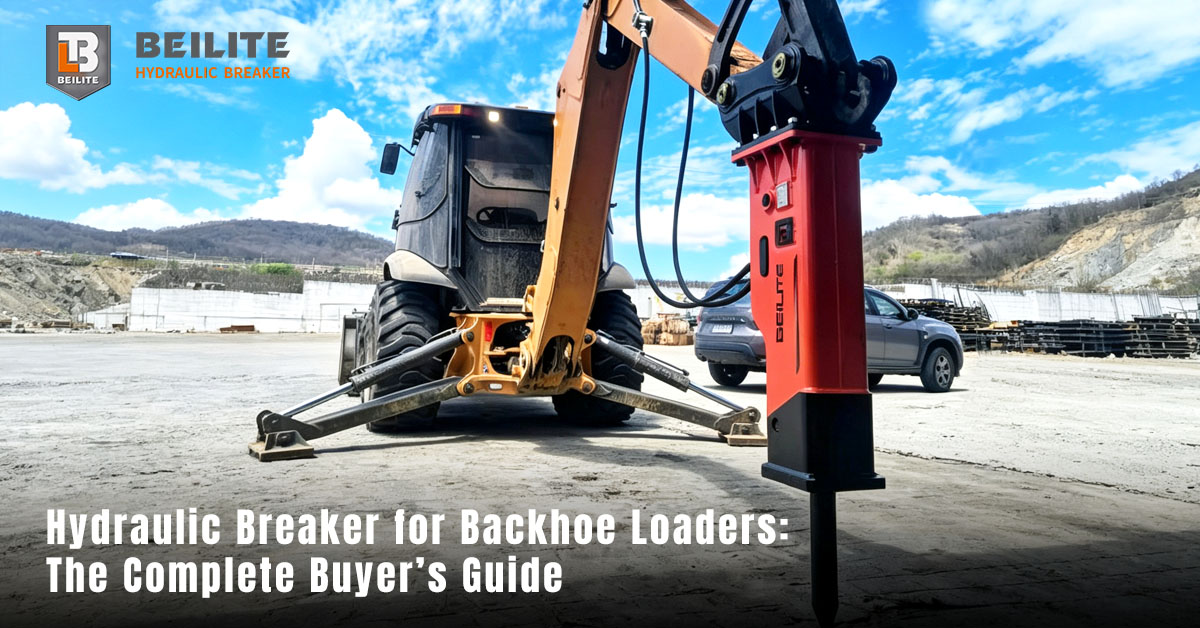
Hydraulic Breaker for Backhoe Loaders: The Complete Buyer’s Guide
2026-09-16

Knowing when to replace your hydraulic breaker can mean the difference between high uptime and unexpected equipment failure on critical jobs. While these tools are engineered for rugged environments, no hydraulic hammer lasts forever. Ignoring the warning signs of severe wear or damage can lead to escalating maintenance costs, structural failures, and even safety risks.
So how do you know whether it’s time to replace rather than repair? we’ll walk through key indicators of end-of-life for hydraulic breakers, share field-tested decision-making frameworks, and explain how BEILITE designs tools that last longer in demanding conditions like quarrying, demolition, and underground tunneling.
Every hydraulic breaker undergoes extreme mechanical stress. Thousands of high-frequency impacts per minute cause gradual fatigue in the piston, front head, and bushings. Eventually, repairs become too frequent or too expensive relative to the breaker’s value.
Even with good maintenance, common wear mechanisms include:
Just like an excavator or haul truck has a replacement threshold based on usage hours and cost-of-repair ratios, your breaker hammer should be assessed using clear performance and cost data.
Let’s break down the most common red flags indicating that your hydraulic breaker may have reached the end of its useful life.
When the seal kit has been replaced multiple times in a season and you’re still getting leaks, this is a sign that internal components (like the cylinder or valve housing) are worn beyond tolerance. Leaking oil isn’t just a mess—it reduces performance and puts your entire hydraulic system at risk.
The piston is the heart of the breaker. If it becomes scored, cracked, or bent, it can lead to abnormal impact patterns and damage to the tool and bushings. Severe piston damage is often a sign of systemic misalignment or frame fatigue—both of which justify a full replacement.
If your inner and outer bushings are wearing out abnormally fast, even after recent replacements, the front head may be ovalized or cracked. Repairing or machining this part repeatedly becomes cost-prohibitive over time.
When your accumulator can’t hold nitrogen pressure for more than a few shifts—even after diaphragm or charging valve replacement—it’s time to consider replacement. Persistent failure here reduces impact energy and risks damaging the carrier.
Visible cracks in the breaker box, distorted side plates, or elongation of bolt holes indicate frame fatigue. These issues are safety-critical and can’t always be repaired effectively, especially if the unit has suffered a side load or a dropped tool impact.
Even a high-quality hydraulic hammer can wear out prematurely if used improperly. Here are the biggest contributing factors:
<Beilite Hydraulic Breakers Maintenance and Operation: 3 Key Things You Should Know>>
Let’s look at this like a fleet manager would. Here’s a simplified way to decide whether to replace or repair:
| Assessment Metric | Repair if… | Replace if… |
| Repair cost vs. breaker value | < 40% | > 50% |
| Downtime impact | Minimal – backup units available | High – site delay cost exceeds breaker value |
| Number of repairs in last 12 months | ≤ 2 | ≥ 4 |
| Structural integrity | Front head & cylinder housing intact | Frame crack, distortion, bolt hole elongation |
| Accumulator holding pressure | Stable after nitrogen charge | Leaks repeatedly, diaphragm rupture |
When the cost of restoring the breaker exceeds half its market value—and especially if structural cracks or housing deformation are present—it’s time to plan for a replacement.
One client operating in a limestone quarry in Southeast Asia delayed replacing a worn-out BLT190 hydraulic breaker for over a year. They spent over $12,000 in accumulated part costs—pistons, seal kits, accumulators—plus lost production due to multiple breakdowns.
Once we inspected the middle cylinder, it had micro-cracks and an oval piston bore—making future repairs pointless. After upgrading to the BLTB-200 silent-type breaker, they saw 22% more uptime and avoided further emergency repair costs.
Not all breakers are built equally. At BEILITE, we design every unit with service life in mind:
Before your next investment, follow these operational best practices to delay the next replacement:
In the field, your time is your most valuable asset. Constant repairs drain manpower, interrupt job flow, and hurt your margins. Replacing your hydraulic breaker proactively—before failure—protects your productivity and your crew’s safety.
We’ve seen too many operators hold on to a dying unit out of habit, only to pay for it with lost weeks of output. With the right assessment tools, and a quality replacement from BEILITE, you can avoid that trap.
Need help calculating the remaining lifespan of your hydraulic breaker? Contact our team for a free evaluation and get personalized upgrade options based on your fleet, material type, and usage pattern.






 Phone/ Whatsapp:
  Email: